Penang in Malaysia had been a place we wanted to visit for a long time, but average airfares of more than NT$10,000 always stopped us from booking. One day, on a whim, it struck us that spending more than NT$10,000 on Penang alone felt a bit steep, while spending about the same to see two of Malaysia’s main cities, Kuala Lumpur and Penang, seemed like better value. So over the Dragon Boat Festival long weekend we planned a six-day, five-night trip: into Malaysia through Kuala Lumpur, and back to Taiwan from Penang. Looking back, once the travel itch hits, you can come up with any reason.
- Malaysia independent travel: What kind of country is Malaysia?
- Malaysia independent travel: Getting from Taiwan to Malaysia and clearing immigration
- Malaysia independent travel: Currency and exchange
- Malaysia independent travel: Getting around Kuala Lumpur
- Malaysia independent travel: Weather
- Malaysia independent travel: Voltage and plugs
- Malaysia independent travel: In short
Malaysia independent travel: What kind of country is Malaysia?
Malaysia’s population is made up mainly of Malays, Chinese, and Indians. The official language is Malay, and English is widely used. Chinese characters are everywhere, and in places with many Chinese people, speaking Chinese is no problem. Even Taiwanese Hokkien can get you through. It is a friendly country for travelers from Taiwan. Walk into an Indian neighborhood, though, and the strong accent in English may leave you completely lost.
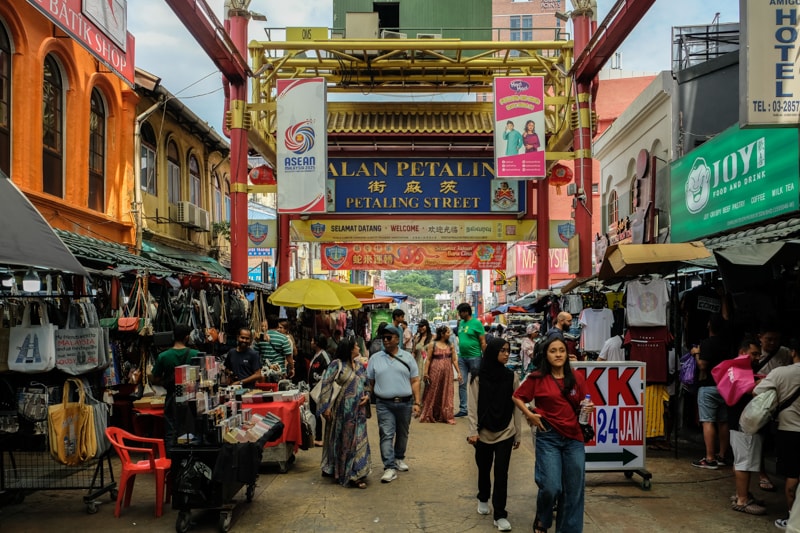
▼Even on Petaling Street, a Chinese gathering spot, you see people of every background.
In short, Malaysia is a country where many ethnic groups live together. On the street you see all kinds of people and hear all kinds of languages. Several communities have built a mixed culture here, and you can see the openness locals show after those cultures and ethnic groups have blended.
Malaysia independent travel: Getting from Taiwan to Malaysia and clearing immigration
Taiwanese airlines flying to Kuala Lumpur right now are China Airlines, EVA Air, and Starlux Airlines. We were entering through Kuala Lumpur and leaving through Penang, and the only airline with a direct Penang flight was China Airlines, so China Airlines was the natural first choice into Kuala Lumpur as well. The timing was good: depart at 8:45 in the morning and reach Kuala Lumpur at 1:25 in the afternoon, with no time difference from Taiwan. This Kuala Lumpur flight was on a China Airlines 777-300ER. The ride was pleasant, the entertainment system was easy to use, and the economy seat suited me. I slept comfortably all the way to Kuala Lumpur.
▼This is our China Airlines flight. An 8:45 morning departure worked well.
If you hold a Taiwan passport, remember to apply online for the MDAC (Malaysia Digital Arrival Card) within three days before entry. You can then use the electronic fast track, and immigration really is astonishingly quick. We will write a separate guide later on how to apply for the MDAC.
Malaysia independent travel: Currency and exchange
Malaysia’s currency is called the ringgit. The name comes from the Malay “Ringgit Malaysia,” shortened to RM. The international code is MYR, and people often just say “Malaysian dollars.” Against the New Taiwan dollar, about 1 ringgit exchanged for NT$7.3 to 7.4. My simple method is to multiply by 7 for a rough price in TWD.
For exchange, we went toBukit Bintang shopping centre nearby, at Suka Money Changers Sdn. Bhd. to change money. Across from the central station, NU Sentral has two exchange counters on the ground floor. People say both rates are better than Bukit Bintang, but our schedule left no time to compare.
▼The money changer in Bukit Bintang, Suka Money Changers Sdn. Bhd..
Malaysia independent travel: Getting around Kuala Lumpur
If you are not on a long stay in Malaysia and your time is limited, we always recommend Southeast Asia’s ride-hailing staple, “Grab.” Before you leave, download the app and link a credit card, and you can move around Malaysia freely. It is safe, and nobody invents the fare. We used Grab for every ride this trip. You do not have to study an unfamiliar transit network or keep transferring. It really is convenient.
Malaysia’s highway eTag tolls, from what we saw, sometimes let you pass and pay by sensor, and sometimes still need you to lower the window and tap, the way you tap an EasyCard. On one Grab ride along the highway, the driver suddenly pulled out a fly swatter. I wondered why there would be flies in the car. He had stuck the sensor card to it, so he could hold it out the window and tap more easily.
▼Malaysia’s eTag system.
▼Ordinary motorcycles are allowed on Malaysian highways. I kept gasping that this was far too dangerous, and I thought that if Taiwan opened highways to motorcycles, the scene would be something else.
Malaysia independent travel: Weather
Malaysia has a typical tropical climate. We traveled at the end of May, and the heat was extreme. Always carry drinking water and keep topping it up, or an afternoon outdoors can really end in heatstroke. For afternoon plans, indoor time works better. Cafe hopping is a good choice, and if the hotel is nearby you can go back, shower, and rest. A small folding umbrella is worth packing. Afternoon thunderstorms start whenever they feel like it, and if it does not rain you can use the umbrella for shade.
▼The afternoon was too hot, so we hid in a cafe.
▼Keep an umbrella with you. It works for rain or as a sunshade.
Malaysia independent travel: Voltage and plugs
Hotels we stayed in before almost always had universal sockets, so the universal adapter we packed rarely got used. In Malaysia it finally did. Malaysia was once under British rule, so the sockets are the British type, with three rectangular pins. Malaysia’s standard voltage is 230V and the frequency is 50Hz, unlike Taiwan’s 110V. Phones and laptops have their own adapters, so those are fine. If you bring your own appliance, such as a hair dryer, check whether it supports 220V.
▼This universal adapter must be about ten years old. It finally earned its place on this Malaysia trip.
Malaysia independent travel: In short
Malaysia is genuinely friendly to visitors from Taiwan. Entry is visa-free, and after you fill in the MDAC, Kuala Lumpur International Airport also has electronic fast-track immigration. That is a feeling we otherwise get only when coming home. This time we were through from landing to exit in under half an hour. Waiting for the bags took longer. Because so many ethnic groups live together, whatever kind of appetite you have, you can find food that fits. Do try the street snacks: nasi lemak, char kway teow, bak kut teh, and roti canai. You can do what we did, street food for breakfast and lunch, then a traditional Nyonya restaurant at night. We will share those meals one by one later.
If Malaysia still feels hard to picture, you can also look at itineraries and experiences on online platforms, along with deals on attraction tickets and hotels. They are worth a glance.