Osaka without USJ: recommended sights and tickets
Many people put USJ on the plan the first time they arrange an independent trip to Osaka. If you are not going to USJ this time, central Osaka still has plenty of places worth scheduling.
Skipping USJ makes the schedule more flexible and the budget easier to control. USJ usually takes a full day, and the ticket, Express Pass, park food, and souvenirs push the total up. If this trip is mainly city sightseeing, food, shopping, night views, and cultural spots in Osaka, leaving USJ out can feel more relaxed.
If you skip USJ in Osaka, places worth adding include Osaka Castle, Tsutenkaku, Shinsekai, the Umeda Sky Building, Dotonbori, Shinsaibashi, Kuromon Market, Tennoji, Abeno Harukas, Kaiyukan, and the Tempozan Ferris Wheel and other sights. For tickets, choose by the itinerary: the Osaka Amazing Pass, Osaka e-Pass, or ICOCA. If you will cover several sights in one day, the Osaka Amazing Pass is more likely to pay off. If you are mainly walking and eating, ICOCA is more flexible.
Is Osaka still worth it without USJ?
Yes. Osaka itself is a city that suits independent travel. It does not have to include USJ to be enjoyable.
If you like food, focus on Dotonbori, Kuromon Market, Tenma, the Umeda underground mall, and kushikatsu in Shinsekai.
If you like shopping, plan Shinsaibashi, Namba, Umeda department stores, and the Nipponbashi electronics street.
If you like night views, go to the Umeda Sky Building, Abeno Harukas, and the Tempozan Ferris Wheel.
If you like culture and city scenery, plan Osaka Castle, Nakanoshima, Shitennoji, and Sumiyoshi Taisha.
The biggest advantage of skipping USJ is that you do not lock a whole day inside one park. On a 3-day, 2-night or 4-day, 3-night independent trip to Osaka, you can fit in more city sights and spend less energy on queues and getting around.
Osaka without USJ, stop 1: Osaka Castle
Osaka Castle is one of Osaka’s most recognizable historic sights, and it fits a first independent trip to Osaka well.
The area around Osaka Castle is large. Besides the main keep, there are Osaka Castle Park, the moat, cherry-blossom scenery, and the Osaka Castle Gozabune. If you do not want to spend much on tickets, you can just walk Osaka Castle Park and photograph the exterior.
Morning is a good time for Osaka Castle: the light is better for photos and the crowds are easier. Both spring cherry blossoms and autumn maples suit a walk here.
Best for: A first independent trip to Osaka, people who like historic sights, and anyone who wants a photo of an Osaka landmark.
Suggested time: 1.5–3 hours.
Nearby: Osaka Castle Park, Nakanoshima, Tenmabashi, and Morinomiya.
Osaka without USJ, stop 2: Tsutenkaku and Shinsekai
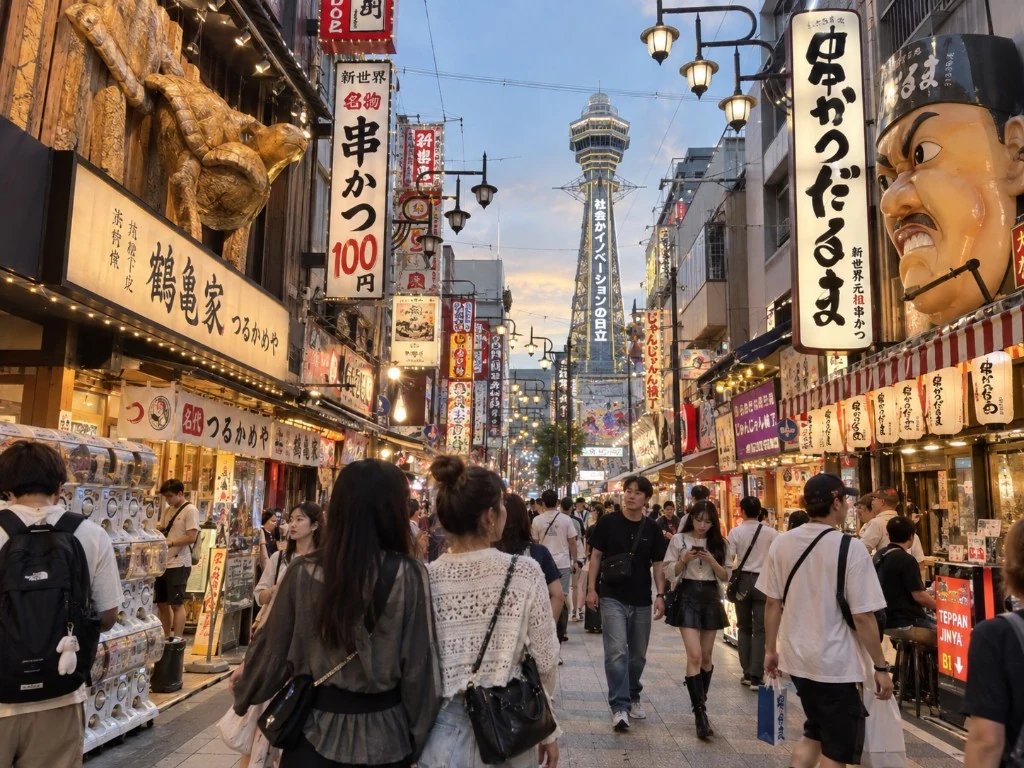
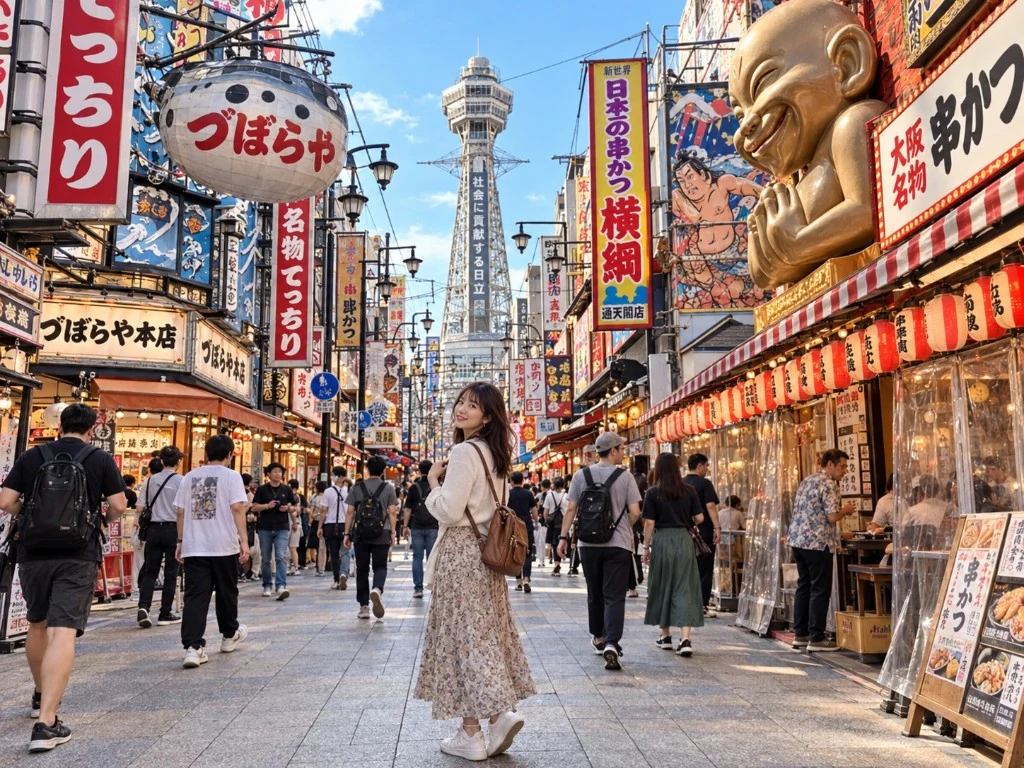
Tsutenkaku and Shinsekai are a retro part of Osaka. Oversized signs, kushikatsu shops, old streets, and everyday Osaka culture make it a good place for photos and food.
If you want a neighborhood that feels more like Osaka, Shinsekai has more character than a typical department-store district. Street photos work in the daytime, and the neon is atmospheric after dark.
Tsutenkaku itself is a classic Osaka landmark, with many kushikatsu restaurants nearby. If your trip includes the Osaka Amazing Pass, check whether Tsutenkaku is a participating facility in the current period before you build it into the ticket plan. The Osaka Amazing Pass also notes that opening hours and regular closing days at sightseeing spots can change, so confirm facility details before you leave.
Best for: People who like retro streets, food, and photos.
Suggested time: 1.5–2.5 hours.
Nearby: Shinsekai, Tennoji, Abeno Harukas, and Shitennoji.
Osaka without USJ, stop 3: Umeda Sky Building Floating Garden
If you are skipping USJ but still want a memorable stop, the Umeda Sky Building Floating Garden fits an evening plan.
The Umeda Sky Building is a signature observation spot in Umeda, Osaka. From the Floating Garden you look over central Osaka, and the view opens up in good weather. The official site also explains the walk from Umeda Station on the Osaka Metro Midosuji Line, so it pairs well with shopping in Umeda.
If you like night views, arrive before dusk so you can watch sunset turn into the city lights. Umeda itself has department stores, an underground mall, and restaurants, so half a day here is easy to fill.
Best for: Couples, people who like night views, and anyone who wants cityscape photos.
Suggested time: 1–2 hours.
Nearby: Umeda department stores, Grand Front Osaka, HEP FIVE, and Hankyu Department Store.
Osaka without USJ, stop 4: Dotonbori and Shinsaibashi
Dotonbori and Shinsaibashi are almost essential on an independent trip to Osaka. You can spend a long time here without buying a ticket.
Dotonbori has the Glico running-man sign, Ebisu Bridge, riverside night views, takoyaki, ramen, crab dishes, and large signs. Shinsaibashi is the main shopping area, with drugstores, clothing, trend brands, department stores, and souvenir shops.
If you are skipping USJ, put the first evening or the last day here. Dotonbori is livelier at night, which suits photos and a late meal. Shinsaibashi is the better slot for shopping.
Best for: A first independent trip to Osaka, people who like food and shopping, and anyone who wants classic Osaka photos.
Suggested time: 2–4 hours.
Nearby: Namba, Kuromon Market, Amerikamura, and Nipponbashi.
Osaka without USJ, stop 5: Kuromon Market
Kuromon Market works well in the morning or at midday. Seafood, wagyu skewers, sushi, grilled items, fruit, desserts, and snacks make it a familiar food stop on an independent trip to Osaka.
Kuromon Market is quite tourist-oriented, and some items are not inexpensive. Treat it as a place to try Osaka market food, not simply as a way to save money.
If you stay near Namba, Nipponbashi, or Shinsaibashi, Kuromon Market is easy to reach, and it also suits a short walk before you head back.
Best for: People who like market snacks, seafood, and street food.
Suggested time: 1–2 hours.
Nearby: Nipponbashi, Namba, and Dotonbori.
Osaka without USJ, stop 6: Abeno Harukas and Tennoji
Abeno Harukas is a signature high-rise observation spot on the south side of Osaka, in the Tennoji area. It suits people who like night views, cityscapes, and department-store shopping.
Compared with Namba and Shinsaibashi, hotel prices in Tennoji are sometimes more flexible. If you want to save on lodging and still keep transport reasonable, put Tennoji on the shortlist.
Around Tennoji you also have Shitennoji, Tennoji Park, Dobutsuen-mae, and Shinsekai, so the area can share a day with Tsutenkaku.
Best for: People who like night views, want to avoid the busiest tourist shopping streets, or are staying near Tennoji.
Suggested time: 2–3 hours.
Nearby: Shitennoji, Tennoji Park, Shinsekai, and Tsutenkaku.
Osaka without USJ, stop 7: Kaiyukan and the Tempozan Ferris Wheel
If you are traveling with children, or you want a comfortable stop that depends less on the weather, Kaiyukan is a good fit.
Kaiyukan is in the Osaka port area and is a popular aquarium in Osaka. Nearby are the Tempozan Ferris Wheel, a shopping mall, and the Santa Maria sightseeing boat, so the area suits half a day to a full day.
This area is a bit farther from the city center, so do not force it onto the same day as too many downtown stops. Treat it as a half day in the bay area: the aquarium in the afternoon, the Ferris wheel or sightseeing boat toward evening, then dinner back in Namba or Umeda.
Best for: Family trips, couples, and people who like aquariums and bay views.
Suggested time: 3–5 hours.
Nearby: the Tempozan Ferris Wheel, the Santa Maria, and Tempozan Marketplace.
Osaka without USJ, stop 8: Nakanoshima and the Kitahama café streets
If you do not want only the tourist route, Nakanoshima and Kitahama suit half a day.
This area has river views, historic buildings, cafés, a slower creative neighborhood, and Osaka City Central Public Hall. Compared with Dotonbori and Shinsaibashi, the pace is slower and the photos feel more like the city itself.
If you want a bit of everyday Osaka on an independent trip, and you do not want the whole trip to be drugstores and department stores, put Nakanoshima and Kitahama in the morning or at café time.
Best for: People who like cafés, city walks, photos, and slow travel.
Suggested time: 2–3 hours.
Nearby: Yodoyabashi, Honmachi, and Umeda.
Osaka without USJ, ticket 1: Osaka Amazing Pass
The Osaka Amazing Pass suits people who are skipping USJ but want to cover many central Osaka sights in one day.
The Osaka Amazing Pass combines transport and attraction entry. The official 2026 prices are 3,500 yen for a 1-day pass and 5,000 yen for a 2-day pass. Sales run from March 25, 2026 through March 31, 2027.
The Osaka Amazing Pass says cardholders can enter the listed participating sights without paying the facility fee that day, and can use more than one facility within a day, but each sight has a limit on how many times it can be used during the validity period.
Who is the Osaka Amazing Pass for?
The Osaka Amazing Pass suits these travelers:
You will visit 3 or more participating sights in one day.
You want facilities such as Tsutenkaku, the Osaka Castle area, the Umeda observation deck, or a sightseeing boat.
You want to group the sights on the same day.
You do not want to buy a separate ticket at every sight.
You will take several rides on the Osaka Metro or other transport in central Osaka.
Who is the Osaka Amazing Pass not for?
If you are mainly walking Shinsaibashi, Dotonbori, Umeda department stores, and Kuromon Market, with few attraction tickets, the Osaka Amazing Pass may not pay off.
If the pace is loose and you only visit one or two sights in a day, you may not need to buy it.
Osaka without USJ, ticket 2: Osaka e-Pass
Osaka e-Pass suits people who want to visit Osaka sights but do not necessarily need unlimited rides.
Osaka e-Pass says the ticket admits you with a QR code and covers more than 25 sightseeing spots in Osaka. It leans toward an attraction pass, unlike the Osaka Amazing Pass, which is built around transport plus sights.
Who is Osaka e-Pass for?
Osaka e-Pass suits these travelers:
You want several sights, but you prefer to tap ICOCA for transport.
You are staying near the sights and do not need many subway rides.
You want to keep the itinerary flexible.
You do not want a transport ticket to constrain the plan.
Who is Osaka e-Pass not for?
If you will take many subway rides in one day and want transport and sights handled together, the Osaka Amazing Pass may be more straightforward.
If you only plan to shop, eat, and take photos, and you rarely enter paid sights, you may not need Osaka e-Pass.
Osaka without USJ, ticket 3: ICOCA
ICOCA is the transport IC card that best fits a flexible independent trip.
If you are skipping USJ and do not want ticket rules to lock the plan, ICOCA is often enough. You can ride the subway, private railways, and JR with it, and pay at some convenience stores and shops.
On a first independent trip to Osaka, the main advantage of ICOCA is simplicity. You do not have to keep calculating how many subway rides, or how many sights, you need before it breaks even. Top it up, then tap in and out.
Who is ICOCA for?
The trip is mainly food, shopping, and walking.
There are not many sights, and you do not want a pass.
You only take 2–4 rides a day.
You want room to change the plan on the spot.
You do not want to study ticket rules.
Who is ICOCA not for?
If you pack several paid sights into one day, ICOCA only covers transport. It does not reduce admission. In that case, compare the Osaka Amazing Pass or Osaka e-Pass.
How do you choose among the Osaka Amazing Pass, Osaka e-Pass, and ICOCA?
If you are skipping USJ, choose the ticket by how many sights you will visit.
| Trip type | Recommended ticket |
|---|---|
| 3 or more paid sights in one day | Osaka Amazing Pass |
| You want the sights, but you want to tap your own card for transport | Osaka e-Pass |
| Mainly shopping streets, food, and shopping | ICOCA |
| A first independent trip to Osaka, and you do not want to study tickets | ICOCA |
| You want to save on admission and pack the sights in | Osaka Amazing Pass |
| Family or slow travel, and you do not want to rush | ICOCA, or buy tickets one by one |
The simplest way to decide:
If you will visit several Osaka Amazing Pass partner sights in one day, consider the Osaka Amazing Pass.
If you want the sights but will not move around much, compare Osaka e-Pass.
If you are mainly shopping and eating, ICOCA is enough.
A 3-day, 2-night Osaka itinerary without USJ
Day 1: Arrive in Osaka, Namba, Dotonbori, Shinsaibashi
Day 1 usually goes to immigration, the ride into the city, and leaving bags at the hotel, so do not schedule too many paid sights.
If you stay in Namba, Shinsaibashi, or Nipponbashi, drop the bags at the hotel first, then walk Dotonbori, Ebisu Bridge, and the Shinsaibashi shopping street in the afternoon. In the evening, have takoyaki, ramen, kushikatsu, or izakaya food.
ICOCA is enough for this day. You do not necessarily need the Osaka Amazing Pass.
Day 2: Osaka Castle, Tsutenkaku, Shinsekai, Umeda night view
Day 2 can be the central Osaka sights day. If you want to use the Osaka Amazing Pass, group the participating sights on this day.
Go to Osaka Castle and Osaka Castle Park in the morning, eat kushikatsu in Shinsekai at midday, do Tsutenkaku or Tennoji in the afternoon, and see the night view from the Umeda Sky Building in the evening.
If this day includes several paid sights, you can judge whether the Osaka Amazing Pass pays off.
Day 3: Kuromon Market, Nipponbashi, souvenirs, departure
Day 3 usually has to match the flight, so stay near the hotel or somewhere easy to reach.
If you stay near Namba, eat at Kuromon Market in the morning, walk Nipponbashi or the Namba shopping area, then return to the hotel for the bags and head to Kansai Airport.
Do not schedule a distant sight on this day, so you are not moving with luggage or missing the flight.
A two-day sightseeing route in Osaka without USJ
If you only have two full days, you can arrange them like this:
Day 1, a classic central Osaka route: Osaka Castle, Shinsekai, Tsutenkaku, and Dotonbori.
Day 2, an Umeda and shopping route: Nakanoshima, Kitahama cafés, Umeda department stores, and the Umeda Sky Building.
If you prefer family sights, change one of the days to Kaiyukan, the Tempozan Ferris Wheel, and the Port of Osaka.
Is Osaka cheaper without USJ?
In most cases, yes. It costs less.
Besides the ticket, USJ can also mean an Express Pass, park food, merchandise, lockers, and transport. If you skip USJ, that money can go to central Osaka sights, food, a hotel upgrade, or shopping.
A 3-day, 2-night Osaka trip without USJ, focused on city sights, food, and shopping, is usually easier to control per person, excluding airfare, than an itinerary that includes USJ.
If you put the savings into a luxury hotel, fine dining, or a lot of shopping, the total can still rise. Whether you save money depends on how you spend.
Osaka without USJ
Is Osaka still worth visiting without USJ?
Yes. Osaka has food, shopping, historic sights, night views, markets, observation decks, and bay spots. You can still fill a 3-day, 2-night or 4-day, 3-night independent trip without USJ.
Where can you go in Osaka if you skip USJ?
Good options include Osaka Castle, Tsutenkaku, Shinsekai, the Umeda Sky Building, Dotonbori, Shinsaibashi, Kuromon Market, Abeno Harukas, Tennoji, Kaiyukan, the Tempozan Ferris Wheel, Nakanoshima, and Kitahama.
Do you still need the Osaka Amazing Pass if you skip USJ?
If you will visit several Osaka Amazing Pass partner sights in one day, such as the Osaka Castle area, Tsutenkaku, the Umeda observation deck, or a sightseeing boat, consider buying it. If the trip is mainly shopping streets, food, and shopping, ICOCA is more flexible.
What is the difference between the Osaka Amazing Pass and Osaka e-Pass?
The Osaka Amazing Pass leans toward a transport-plus-sights bundle, for people who ride a lot and visit several sights in one day. Osaka e-Pass leans toward an attraction pass, for people who want the sights but prefer to arrange transport themselves.
How do you plan 3 days and 2 nights in Osaka without USJ?
Day 1 can be Namba, Dotonbori, and Shinsaibashi. Day 2 can be Osaka Castle, Tsutenkaku, Shinsekai, and the Umeda night view. Day 3 can be Kuromon Market, Nipponbashi, and souvenir shopping, then the airport.
Is Osaka cheaper if you skip USJ?
It is usually cheaper, because you skip the USJ ticket, Express Pass, park food, and merchandise. If that budget moves to fine dining, hotels, or a lot of shopping, the total can still rise.
On a first independent trip to Osaka, will it feel empty without USJ?
No. Osaka has plenty of city sights, food, and shopping, and 3 days and 2 nights fill up easily. Skipping USJ makes the plan more flexible, because you do not have to lock a whole day inside the park.
Skipping USJ in Osaka does not make the trip dull. You can give that time to the city itself: Osaka Castle, Tsutenkaku, Dotonbori, Shinsaibashi, the Umeda night view, Kuromon Market, Kaiyukan, and a walk on Nakanoshima.
If you like sights, consider the Osaka Amazing Pass or Osaka e-Pass. If you prefer food, shopping, and a flexible plan, ICOCA is already enough.
For a first independent trip to Osaka, 3 days and 2 nights without USJ is more relaxed and easier on the budget. First decide whether you are traveling for sights, shopping, food, or with family, then choose the ticket and route that fit. You can put together an unhurried trip that stays within budget and still feels like Osaka.